The Hidden Order in ‘Messy’ Play: How Understanding Play Patterns Helps Children Feel Safe and Confident
If your toddler or preschooler dumps toys, lines up cars for hours, or spins lids and cups repeatedly, it can feel chaotic - and stressful. But what looks like “messy play” is often your child following natural play patterns that help them learn, regulate, and feel safe. Understanding these patterns helps parents respond calmly, reduce power struggles, and support child development at home.
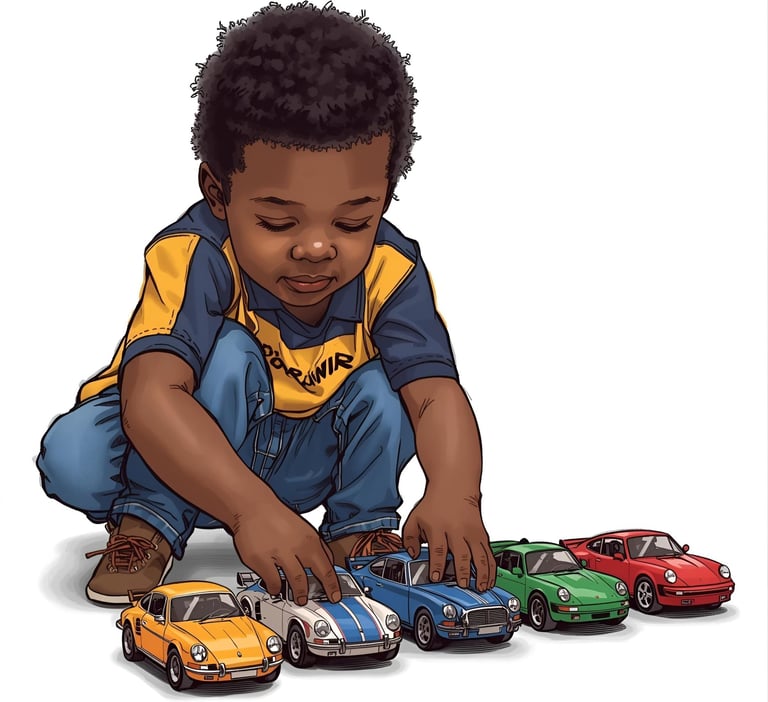
Have you ever watched your child dump an entire basket of blocks onto the floor and thought, “Here we go again - chaos!”? Or noticed them lining up cars, spinning lids, or twirling toys for what seems like forever?
Take a deep breath - it’s not random. It’s not “just being difficult,” and it’s not something to stress over.
This is play pattern behaviour in action. And it’s a beautiful, predictable, and essential way children make sense of their world.
1. What Are Play Patterns?
Play patterns are repeated ways children explore their environment, helping them understand how the world works, even before they have the words to explain it.
Common patterns include:
Carrying & Gathering: moving and collecting objects
Filling & Containing: putting things in containers, pouring, scooping
Movement & Impact: throwing, dropping, or crashing objects
Spinning & Turning: twisting, rolling, or spinning objects
Connecting & Building: stacking, joining pieces, lining up objects
Notice a pattern? These repeated behaviours are children experimenting, predicting, and learning cause and effect.
2. Why ‘Messy’ Play Is Actually Orderly
When a child dumps blocks, lines up cars, or spins lids, they are:
Regulating themselves: Repetition helps children feel calm and in control
Testing cause and effect: Dropping, stacking, spinning - all teach balance, gravity, and movement
Problem-solving: Each action is an experiment: “What happens if I stack it differently?”
So that “mess” is really a carefully orchestrated learning environment, designed by your child. The more predictable the pattern, the safer and more confident they feel.
3. How Loose Parts Support Learning
Loose parts are open-ended items like lids, baskets, stones, fabrics, or household objects. They are perfect for exploring play patterns.
Why? Because children need options, not instructions. A child transporting stones from one basket to another is practising carrying and gathering. With loose parts, they can repeat, experiment, and self-regulate in meaningful ways.
4. Seeing Behaviour Through a Play Pattern Lens
Next time your child seems to “dump everything” or line up the same cars:
Ask yourself what pattern they’re exploring
Observe before intervening
Provide open-ended resources to continue exploration safely
When you see intention behind the behaviour, chaos turns into learning. Calm often follows naturally, not because the child changes, but because your lens does.
5. How This Supports Calm and Confident Parenting
Understanding and anticipating play patterns helps parents:
Reduce constant redirection
Feel confident rather than frustrated
Support deep, meaningful learning at home
Recognise children’s urges and meet their developmental needs
The “messy” play becomes purposeful, predictable, and deeply meaningful - for your child and you.
6. Want to Understand Your Child’s Behaviour Even Better?
If you want to decode everyday behaviours, understand the “why” behind throwing, stacking, lining up, and messy play, and respond calmly at home, Play Talks: Calmly Understanding Your Child’s Behaviour is your guide.
You might also like:
When Your Child “Destroys” Their Play — It’s Not What You Think
Loose Parts Play at Home: Simple Setups That Spark Curiosity (Without More Toys)
hello@playandpurposeco.com.au
© Play & Purpose Co. 2025. All rights reserved.
We acknowledge the Traditional Custodians of the many lands across Australia. We honour their enduring connection to land, waters, and community. We pay our respects to Elders past and present, and to the children of today - the future generations we walk alongside.