When Your Child “Destroys” Their Play — It’s Not What You Think
If your child constantly pulls toys apart, knocks over towers, or scatters carefully set-up play, it can feel frustrating - even confusing. But what looks like destruction is often your child learning through play. Understanding common play patterns can help you make sense of these behaviours, respond calmly at home, and feel more confident supporting your child’s development.
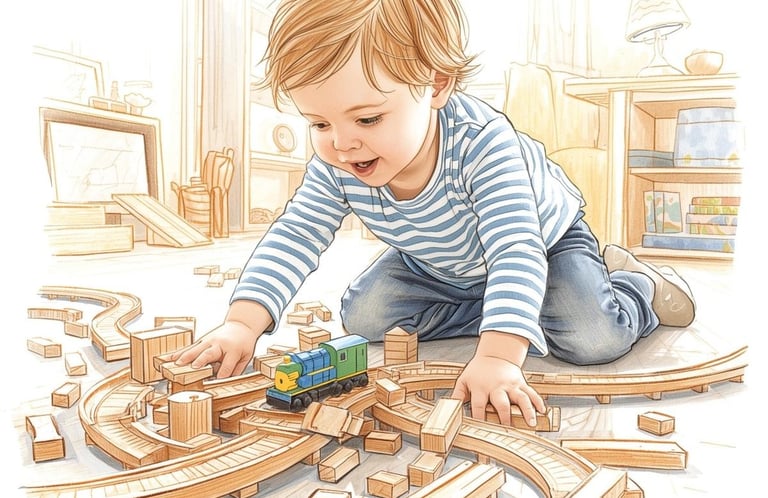
Every morning, the train track was set up. We thought it was their favourite thing.
Carefully connected.
Trains lined up.
Bridges balanced just right.
And every morning, within minutes, it was “ruined”.
Tracks pulled apart.
Carriages carried into other rooms.
Pieces scattered across the house.
If this sounds familiar, you’re not alone.
Many parents find themselves wondering:
Why won’t my child just play with it properly?
Why do they always pull things apart?
Why does every activity end in mess?
As a parent we need to stop and ask some questions, because “What if this isn’t destruction at all?”
A Different Way of Looking at Your Child’s Behaviour
When we stop asking “How do I stop this?”
and start asking “What is my child learning through this?”
everything shifts.
What often looks like chaos is actually a play pattern, a repeated way children explore how the world works.
The train tracks weren’t being ruined.
They were being investigated in a way that made sense to my child.
Children were:
pulling pieces apart to explore how things disconnect
carrying parts around to understand movement and space
rebuilding, crashing, and repeating the same actions again and again
Not to annoy you.
Not to be careless.
But because their brain needed that repetition.
The behaviour didn’t change - the understanding did.
And with that understanding came much more calm.
Movement, Carrying, Pulling Apart: What’s Really Going On?
Many common “challenging” behaviours at home fall into a few key play patterns.
Connecting & Building (and Pulling Apart)
Children are driven to explore:
how things connect
how they come apart
what happens when they change something
At home, this often looks like:
pulling apart train tracks
separating magnetic tiles or Duplo
knocking down towers they just built
removing pieces from sets and carrying them elsewhere
This is not defiance or purposely messy.
It’s your child learning cause and effect.
Carrying & Gathering
When your child:
fills their pockets with toys
carries objects from room to room
piles items into bags, baskets, or boxes
They’re practising coordination, planning, and understanding space.
It’s purposeful, even when it’s inconvenient.
Why This Understanding Changes Everything at Home
When parents understand play patterns:
behaviour feels less personal
frustration softens
expectations become more realistic
the home environment feels calmer
Your child isn’t trying to undo your efforts.
They’re following an internal developmental urge.
Once you see that, it becomes easier to respond without constant correction.
How to Support These Play Patterns at Home
Instead of planning for toys to stay perfect, plan for how children actually play.
You might try:
choosing toys that can be connected and pulled apart easily
expecting mess during play — and designing for it
offering baskets or containers for carrying
providing duplicates when possible to reduce conflict
pausing to observe before stepping in
When children are allowed to follow their natural play patterns, they often become more settled, not more chaotic.
Because their brain is finally getting to do the work it’s asking for.
The Real Shift Isn’t the Toys, It’s the Lens
The train tracks weren’t the problem.
And your child isn’t either.
Once you understand why your child keeps repeating certain behaviours, those same moments start to look different:
more predictable
more meaningful
far less stressful
When we change how we see our children, we change how supported they feel, and how confident we feel as parents.
And that’s where calm really begins.
Want to Understand Your Child’s Behaviour Without Second-Guessing Yourself?
I was lucky enough to learn these things through my professional work in early childhood. And what made sense in the classroom also made sense at home. If you’d like help decoding what your child’s behaviour is communicating, and learning how to respond calmly and confidently at home, Play Talks: Calmly Understanding Your Child’s Behaviour walks you through it step by step, using real-life examples and parent-friendly language.
hello@playandpurposeco.com.au
© Play & Purpose Co. 2025. All rights reserved.
We acknowledge the Traditional Custodians of the many lands across Australia. We honour their enduring connection to land, waters, and community. We pay our respects to Elders past and present, and to the children of today - the future generations we walk alongside.