Schemas at Play: Understanding the Behaviour You Thought Was Destruction
If your carefully set-up play invitations are constantly “destroyed,” you may be seeing schematic play - not challenging behaviour. Understanding schemas like disconnecting and transporting can completely change how you support children and create calmer classrooms. Here’s how recognising learning patterns (instead of correcting them) helps educators plan with confidence and reduce daily stress.
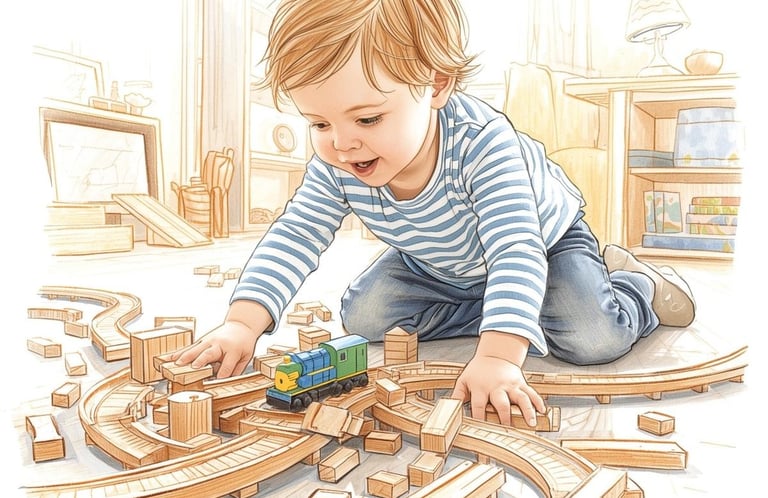
Every day, the train tracks were set up as a provocation.
The focal point of the room.
A beautifully curated invitation - trains lined up, bridges arranged, a picture-perfect invitation to play.
And every day, it was the first thing to be destroyed.
Tracks pulled apart.
Carriages scattered.
Pieces carried across the room.
Educators persisted.
They encouraged children to play the “right way.”
They reset….. and reset again.
Children responded the exact same way.
For months.
The frustration grew…..but the plan didn’t change. Why?
Eventually, the team paused and asked a different question:
“What if the actions are actually telling us something?
What if what we thought were behaviours to manage were simply another way of playing?”
So we tried a new lens.
The train set stayed, but this time, we weren’t expecting it to remain perfectly intact.
Instead, we watched. We listened. We looked for patterns.
And suddenly, the “destruction” made sense.
Children were pulling tracks apart because they were exploring disconnecting schema.
They were carrying pieces across the room because they were exploring transporting.
They were piling, lining, crashing, rebuilding - not to ruin the setup, but to understand how their world fits together.
The frustration softened instantly.
The behaviour hadn’t changed - our lens had.
And those same resources that once felt like a daily battle suddenly became essential tools in each child’s learning journey.
When we stopped fighting the urge and started recognising the pattern, the classroom felt calmer - not because the children changed, but because we did.
The Power of Adjusting Your Lens
One of the biggest shifts in early childhood practice comes when we move from:
“Why are they doing this?” to
“What is this behaviour communicating?”
When you view play through a schema-focused lens, “behaviours” become learning patterns.
Challenges become data points.
And a chaotic room suddenly becomes much more predictable.
Children aren’t trying to undo your setup.
They’re trying to understand the world through repeated actions that make sense to their brains.
When we adjust our expectations, we can adjust the environment too.
Disconnecting Schema in Real Life
The train-track example is classic.
Children exploring disconnecting schema will often:
pull apart train tracks
separate Duplo or magnetic tiles
dismantle towers
“break” connections adults try to maintain
take pieces away from a complete set
It’s not defiance.
It’s developmental logic.
Understanding this helps educators:
plan for dismantling
provide open-ended loose parts that can be taken apart
stop taking it personally when setups don’t stay intact
feel calmer and more in control
actually meet children’s needs rather than fight them
When you stop planning picture-perfect scenes and start planning for patterns, your classroom becomes calmer, not because the children change, but because you see them differently.
So What Does Schema-Smart Planning Look Like?
Instead of planning for the “right way to play,” we plan for the real way children play.
This might mean:
Offering resources that children can connect and disconnect
Expecting destruction and designing for it
Providing duplicates so children can take pieces without conflict
Pairing schema-rich materials with big spaces
Observing before redirecting
The more we honour children’s urges, the more regulated and focused they become.
Because when children can do the work their brain is begging them to do…..everything becomes calmer.
Final Thoughts
The train tracks weren’t the problem.
Our expectations were.
Once we understood the underlying schema, the exact same play looked entirely different - purposeful, predictable, and deeply meaningful.
When we shift the adult lens, we don’t just change our practice.
We change how children are understood, supported, and valued.
And that is where calmer classrooms begin.
hello@playandpurposeco.com.au
© Play & Purpose Co. 2025. All rights reserved.
We acknowledge the Traditional Custodians of the many lands across Australia. We honour their enduring connection to land, waters, and community. We pay our respects to Elders past and present, and to the children of today - the future generations we walk alongside.